Saturday, 26 May 2012

In the Real World

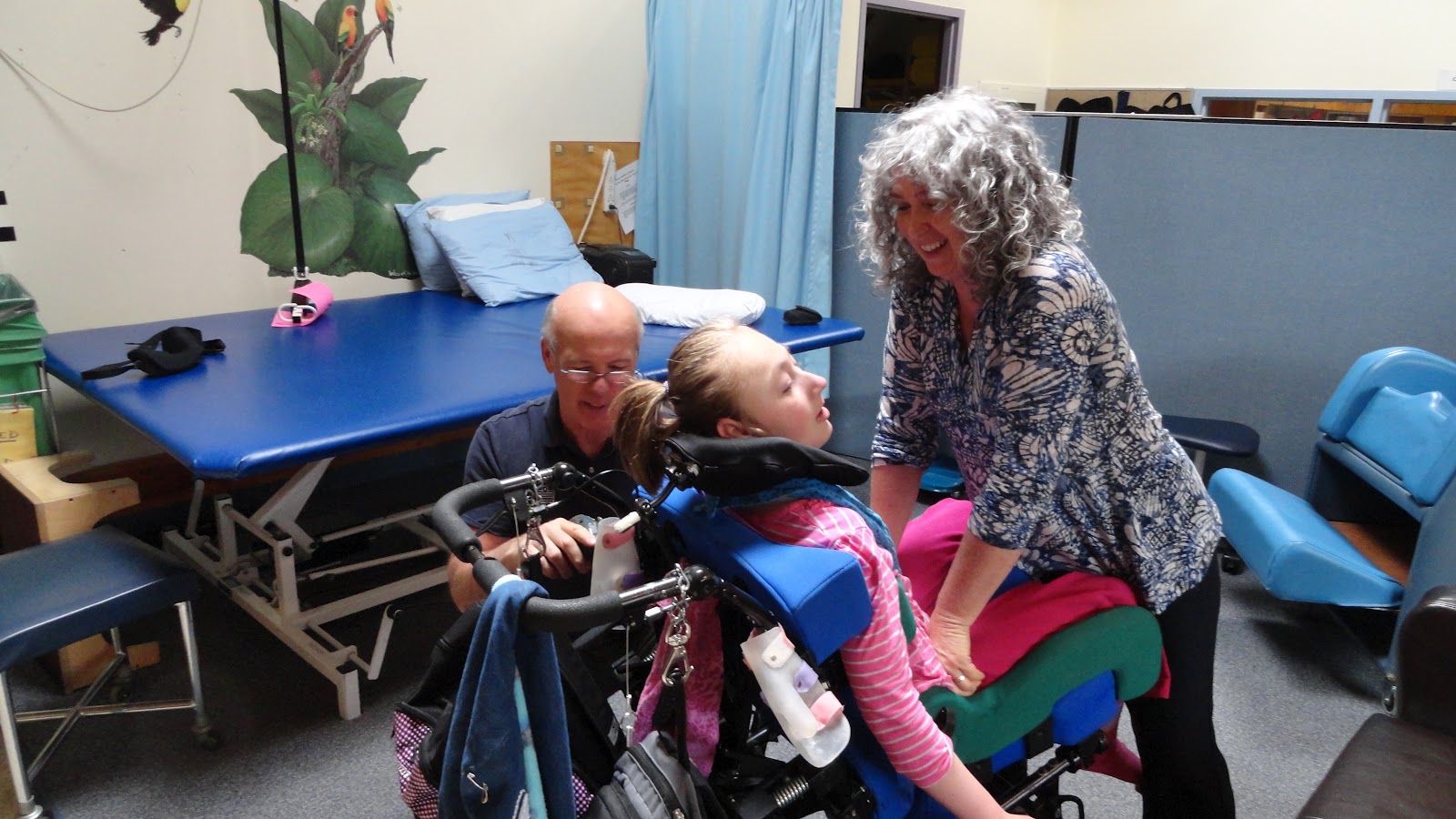
Dave works on the chair while Elaine holds Tas in position
I actually wasn't in school much this week because I needed to take our daughter down to B.C. Children's Hospital for some tests and some work on her wheelchair. I began this week with three days in the "real world", came back and spent a day at school and then finished off today by marking English 12 Provincial Exams.  Let me start with a description of some of my experiences earlier in the week:


The picture above captures the amazing team of Elaine (OT) and Dave (Technician) who have been adapting our daughter Taslyn's wheelchair and positioning devices for over ten years. Basically they (along with the rest of their small team) design and build mobility devices for most of the  handicapped children in the Province of B.C. The work that these two do absolutely fascinates me (and I think they are tired of all my questions!) Basically Dave and Elaine's careers are completely based in collaborative, creative problem solving. They assess the individual needs of each child (spasticity, mobility, positioning etc.) and then the create an original design that will suit the needs of the child, and then they literally build it (on site) over the next few days. There is absolutely no textbook or design manual for the work that they do. Many of the most ingenious designs on our daughter's wheelchair have actually been created by Dave himself. From the beginning of their day to the end they are coming up with creative and individualized solutions. Their job is particularly challenging because as Dave says: "None of these kids play by the rules. There are no rules". Every child has unique demands so Dave and Elaine need to start fresh with each new patient, and because each of the children they work with has a handicap (or many) none of their bodies are "logical". 


Flash forward to the experience I had today. Today I spent approximately 7 hours staring at a computer screen reading hundreds of essays written by students about the same 2 articles on the English 12 Provincial Exam. I found it interesting to think about the fact that it was so different from my very recent experience in the "real world" and yet, aren't provincial exams what we rely on to ensure our graduates are prepared for the rigour and accountability of life after high school? 


The English 12 Provincial E-Exam Marking Committee (Good Times!!)


Here is what I observed in the situation around the English 12 Provincial Exam

  • Students write the exam at the same time and they have a finite time frame (3 hours) to complete the exam
  • All students write identical exam questions regardless of personal interest or background (the three key texts on the May exam were based on a) technology b) hockey goaltenders c) baseball ) 
  • The exam is written completely out of context. The questions are simply "exam questions" and have no higher purpose (once the exams are read and the mark recorded the exams will eventually be discarded)
  • Students write the exam independently
  • Marking the exam is as uninspiring as the writing of it must have been
  • The exam is worth 40% of a student's grade in English 12
  • Students all write the exam under identical conditions (on a computer in a lab). During larger sessions in January and June, students also write in an exam setting such as the one below:
Students at my school during January Exams

In contrast, here is what I observed in the "real world": 

  • Many problems are often not solved on a set time line. For example we had a specific issue with my daughter's wheelchair and Elaine needed to let it "ferment" in her brain overnight. When we came back the next day she had a solution ready. If she had been required to solve it in a three hour limit she would have "failed". 
  • Most problems have more than one possible solution
  • Problems can be solved with the input from more than one person. Elaine often jokes that she and Dave "share a brain". They are constantly consulting with each other, with other members of their team, and with the parents and the children themselves
  • Problems change over time and what once worked may not work in the future and may have to be adapted
  • Solutions just can't be "memorized" if you are always dealing with new issues and situations
  • If an idea fails it just means you need to try another solution (our daughter's wheelchair has been altered many times because initial attempts were not successful)
  • Real problems have a context and a purpose. Dave and Elaine can directly see the impact of their work and the actual people that they are helping. While their work is extremely demanding, they are directly able to experience the results and thus remain inspired and motivated


Now, I do need to provide a disclaimer. As a senior English teacher I must mention that I believe that the skills assessed by the English 12 exam (including reading comprehension, writing, synthesis, and original composition) are completely valid (and extremely important). I also believe that these skills should certainly be assessed in all students. The problem is in the way we assess those skills which completely de-contextualizes everything and (with the exception of the original composition section) leaves no opportunity for personalization or creativity. For the record, approximately 75% of the responses on the original composition section are also presented in a formulaic expository essay format (despite the fact that students are given freedom to respond creatively if they choose). The majority of the test leaves no room for individual interests and completely separates the skills from a real purpose, (and don't even get me started on the multiple choice section!). As provincial exams at the high school level go however, it is potentially superior to the rote memorization of trivia demanded by many sections of the Socials 11 and Science 10 exams. 

Daniel Pink writes:
A quick thought about the disconnect between how we prepare kids for work and how work actually operates:
In school, problems almost always are clearly defined, confined to a single discipline, and have one right answer.
But in the workplace, they’re practically the opposite. Problems are usually poorly defined, multi-disciplinary, and have several possible answers, none of them perfect.


As someone who works with grade 12s I am constantly reminded of my responsibility to prepare students for their lives after high school.  Therefore, if the main argument for provincial exams is that we are enforcing "standards" and "accountability" and "rigour" so that our students are prepared for the "real world" I think we need to think about what "real world" we are actually talking about. The real world I was in for most of the week had very little connection to the provincial exams that I marked today. 

Friday, 18 May 2012

Gone Fishing

A master at work
A practicum student visited our school for 2 days this week, and after a day and a half of classroom lessons we thought it might be nice to hop on a bus with the adventure tourism class and go fishing at a nearby lake. We had some great conversations along the way about taking academic classes on field trips, and the benefits of having students outdoors, but those will be blog topics for another day. The clearest lesson from that afternoon came from 2 particular students on the trip. 


The first student is a young man that I haven't taught since grade 9 (he is currently in grade 11). During his English 9 days he was one of my most frustrating students when it came to effort and work completion. While we had a good personal relationship, he would often refuse to complete written work and he absolutely loathed reading.  There were many one-on-one talks, then eventual trips to the lunch hour homework room and finally meetings with his parents and admin as well as suspensions (for all of his courses not just English). I do remember his mom telling me about his love of outdoor activities including mountain biking, hunting, and fishing. At school however, he simply seemed to suffer through most of his courses. 


Catch #2 (before being released)
In contrast, the boy I watched on that afternoon was truly in his element.  He was confident as he quietly walked down to the dock and within 2 minutes (no exaggeration) of casting his first fly he had hooked a fish.  The adventure tourism teacher took me aside and mentioned that this student had basically taught his unit on fly fishing. He had shown all the other boys how to tie flies and it was obviously something he excelled at. The first fish was released and again within  2 minutes he had caught another. It was phenomenal how effortless the entire thing seemed to be for him. Slowly a number of other boys wandered over to join him on the dock and try to study what he was doing. I watched him patiently set his rod down and help some of his classmates, and I also watched him remain silent even though he knew that 7 more people on the dock casting in the same area were going to greatly reduce his chance of catching more fish. Though he was the only one to catch anything that afternoon he did not ridicule his classmates or gloat about his skill. 

The now crowded dock
There was another student on the trip who I also taught in grade 9. This boy is someone I would definitely have described as a pleasure to have in my English class. He was eager and cooperative and had solid work habits. He was a strong reader, wrote well, and had a great sense of humour.  Unfortunately his skills as an English student did not translate into the fishing arena. The practicum student, adventure tourism teacher and I all watched with mild amusement as he snagged his line again and again and lost lure after lure. Finally (about 30 minutes into the fishing experience) he quit. He wasn't rude or angry about it but he was obviously frustrated to the point that he did not want to continue with the activity. I'll admit that I was a bit surprised how negative the experience was for him and how quickly he gave up. I flashed back to my experiences with the first student in my English class, and I recalled telling him that he needed more perseverance, and that to succeed in life he had to be willing to work at things he wasn't good at. At the time I would have classified him as someone who gave up easily while I definitely felt that student number two had obvious determination, work ethic and resilience. 


Perhaps those were not accurate observations.  Perhaps I was simply observing the students in contexts that played to their individual strengths, and when it came to confidence, skill, and tenacity they were actually both fairly equal. We all like to consider ourselves determined in the face of adversity, but how many of us put ourselves through situations day after day where we are unsuccessful? As an English teacher I observed each student over and over again in situations where one was constantly being rewarded and one was constantly being punished. What if we reversed what we valued in school? What if school was seven blocks of fishing a day and one block of an "academic" subject? Which student would have straight As and which student might be at-risk of not graduating? 


Overall it was a wonderful class because we were able to observe the first student in an environment where he excelled, and could earn the respect of his teachers and peers. No matter what the context, it is always a pleasure to watch someone who is passionate about what they are doing. I was struck by how drastically different that 45 minutes at the lake was to what he faces every day in our school where class after class is a frustration. Just today at lunch I heard his name called (again) over the announcements for not attending homework club. It is actually amazing that he has hung in for this long. I wonder how student number two would respond if he was summoned to homework club at lunch and found a rod and reel waiting for him...

Saturday, 12 May 2012

Nothing Is Interesting If You're Not Interested

Student with a copy of Anna Karenina 

On Friday a student shared with me that her grandmother had passed away, and since I had already been planning on writing a post about this particular student,  I think it's a fitting time to write this.  I taught the young lady in the above photo in my first semester Literature class, and her story is now added to the many experiences that continue to shape my perspective as an educator. 


Please walk briefly back in time with me to Sept. 7th, 2011. It is my second day with my new batch of Grade 12 Literature students, and the epic Anglo-Saxon poem Beowulf is on the agenda. It's a large class and they are shaping up to be a loud and energetic group. They are responding very enthusiastically to some of the activities involving modern culture and music, but at some point they will start to realize that a key component of the course is to read (!) some really old (and often dry) poetry. It is now the moment of truth and I hand out the first 6 pages of Beowulf.  To be fair, Beowulf is long but it isn't that difficult to sell with its heroes, monsters, blood and gore; however, my strongest memory of that 2nd day of class is of the above student commenting (loudly enough for me to hear) as she finishes the first page and then flips ahead:


"Oh my God!! This is SIX PAGES LONG! The MOVIE would be shorter!" 


I certainly realized at the time that this was not a good sign.  While I appreciated the honest feedback, it was definitely going to be a long semester if 6 pages of poetry was too much for a student to tackle. Because of her negative response to the reading my first thought was that she was a struggling learner, as kids who dislike reading often fear length of text above all.  If 6 pages of Beowulf was too much then comprehension was possibly a larger issue.  I mentally lumped this student in with those who strongly disliked reading and therefore required extra encouragement, scaffolding and active options. 


Flash forward to the end of the course in late January 2012 when this student was completing her final assessment. In the course students are given a number of options for a final assessment and one of their choices is a "Cultural Literature"project.   "Cultural Literature" requires students to complete further research beyond the course. They must demonstrate an understanding of the skills taught in Lit 12 (critical literary analysis, awareness of style, technique, context, language etc.) and apply them to literature from their own cultural heritage. Imagine my surprise when this student chose the "Cultural Literature" option instead of  a creative project or a final exam.  I was even more confused when the time came for her to present her final project to me (students present their projects in a 15 minute live interview format) because what came next was certainly not what I would have expected. She began the interview by describing her choice to study Russian Literature for her project and then launched into a reflection on Tolstoy's "Anna Karenina." I almost fell out of my chair. Everyone knows that kids who don't like reading don't decide to tackle one of the lengthiest novels ever written. 


Me: "Did you say Anna Karenina? You didn't seriously read Anna Karenina..THE Anna Karenina"
Student: "Yes, (small sigh of impatience) that's what I said"
Me: Name a character in the book...besides Anna. 
Student: "There's about fifty, but how about Vronsky, Levin, Stiva, Dolly..."


Yes, she had actually read it. My "reluctant reader" had polished off Tolstoy's massively complicated Russian classic. As the interview continued, she explained that her interest in Russian history and culture stemmed from the relationship she had with her Russian grandmother who lived in Penticton and had told her Russian stories since she was a child. Throughout her final project she had discussed what she was reading with her grandmother and had numerous conversations about her grandparents growing up in Russia and living under the reign of Stalin. I was suitably impressed when the student explained the difference between the Russia of "Anna Karenina" (which took place during Tsarist rule) and the experiences of her grandmother while Stalin was in power. Her grandmother's fading health at the time made the exchanges even more valued.


In reality, this student wasn't a struggling reader at all.  She hadn't rejected Beowulf because she couldn't read it, she had rejected it because she didn't care about it. As a teacher, I hadn't done an effective job helping her discover the connections between Beowulf and her own life. It all came down to what was truly relevant in this student's perspective, and in this context it became obvious that 6 pages of Beowulf was too much effort, while 860 pages of Tolstoy was completely reasonable.  I don't think I have ever had a clearer indication of the correlation between relevance and student motivation. Back in September after the student's initially negative response it was easy to consider laziness, low ability,  or inability to focus as culprits when in truth she saw no purpose in reading Beowulf. I know there are many students who balk at reading because of legitimate learning difficulties, but in this case I had identified a struggling learner when in fact I was dealing with an unmotivated one. 


My second semester has given me a chance to try and re-focus my instruction with the idea of relevance at the forefront. It has been considerably "messy" as I try to re-create project options and intros to lessons but the overall result will (hopefully) provide a more meaningful experience for my students, as well as a higher level of engagement and a deeper connection with the material. The experience has also reminded me that up until last year I always kept a sticky note on my desk with the following quote: "Nothing Is Interesting If You're Not Interested".  That quote has been stuck to my computer over the past decade in countless classrooms in three different schools but somehow it got lost over the past year. Thanks to this student, it's now back on my computer monitor where it belongs.


Side Note: Another reason that 2nd day of class is still so clear in my mind is because later that day I recorded a video reflection. My only goal was to demonstrate how a teacher could use a flip camera to reflect (instead of having to write something out) for my inquiry group.  It was simply a sample reflection (and it was the only video reflection I did all year as I prefer to write) but the story I mentioned is the one I ended up describing in this blog. This youtube clip is just a video version of the above post (just trying to differentiate the delivery :-).  I have full permission from the student to use this clip.


Saturday, 5 May 2012

Certainty


There have been a number of different posts this week (in particular this one)  that have made me reflect on why I became an educator.   At its best the career is challenging, ever-changing, honourable, and satisfying;  however, after much reading and thought, I know that the true reason I became a teacher is because of the impact that my own teachers have had on my life.

Growing up, my home situation wasn't the greatest.  The details are irrelevant, but suffice it to say I was one of those students for whom school was my home.  The photo above demonstrates one reason why I felt so comfortable within the walls of my high school. I knew in my heart that I meant something to the people in that building. The card above was written by my Grade 12 French teacher Mrs. Loutit, who gave it to me in class a few weeks before the end of the year.  I remember being amazed that a teacher would take the time to write a personal card to a student. That card meant so much that I still have it today.

The personal effort meant a lot, but it was also what she said in the card that resonated so deeply. She wrote that she had enjoyed teaching me, and that she believed in my future. She explicitly stated that she saw strengths in me that I could not see for myself.  In all honesty, I really wasn't much of a French student,  but I never felt that my abilities in the subject area had any impact on my relationship with Mrs. Loutit. I guess the best way to explain it, is that I was a person she cared about who coincidentally happened to be trying to learn French. 

So many years have passed since she gave me that card, and (thankfully) I am no longer the person I was in my last year of high school. As an adult I am now able to control the factors that caused pain and anxiety during my childhood. I now have the ability to change elements of my life when necessary, but as a teenager I did not have that power.  Here is something I am acutely aware of as a teacher: children grow up to be adults, and those adults remember who believed in them when they were children.  I once listened to  Martin Brokenleg tell a powerful story of adults "singing the song for a child when the child can't sing his own". That's what many of my teachers did for me. They sang my song when I was unable. Now as an adult, I can raise my own voice.

Mrs. Loutit gave me the gift of her care and her belief in me when I was 17 years old, but her greatest gift was that now as a teacher I have a staunch certainty that what I do and say has an impact on the students I teach.  I know that what I do makes a difference. The ability of a teacher to positively (or negatively) impact the life of a student is so strong as to be almost overwhelming.  It is because of Mrs. Loutit that I write cards every year to graduates that I teach. 

In almost 20 years, I have never told her what an impact she had on my life. I've never told her how much that simple gesture of writing a card meant, but is this not also the nature of teaching? We don't always  experience the true results of our efforts in a visible or tangible way,  but because of teachers like Mrs. Loutit, I am unwaveringly confident that those results exist.

Saturday, 28 April 2012

Just Another Thursday

Students recording their project in the recording studio
I had an interesting Thursday a few weeks ago when I was pleasantly surprised three times. The first was when some boys came into the library to use the recording studio.  What was surprising was not their use of the studio, but the fact that one of them was a student of mine who I would never have guessed had any interest in music or singing. He was a junior hockey player who (I assumed) spent most of his time thinking about sports. I would never have anticipated his choice to create a musical project. 


My second surprise came after a short activity in my class where students were asked to draw key images from a poem they were studying. I often try to throw artistic options into my lessons and this was a simple five minute activity. Many students give me stick figures or something equally simplistic, (and that's fine because I'm looking for their understanding of the poem and not their artistic ability). That said, when  I was going through the sketches later that evening I was caught off guard by this:


Again, I was not surprised because of the quality of the drawing, but because I did not expect this type of ability to come from this particular student.  The student was a big, tough, wise-cracking rugby player, and I had no idea he could draw! He whipped off the above sketch in less than five minutes. 


Finally, on that same Thursday, I needed to drive across town after school and 2 students asked me for a ride. One of the students gets into trouble fairly consistently and is known as a difficult student to have in a classroom. We ended up having a chat as I drove, and imagine my surprise when I found out that he plays in his own band, and also takes a Jazz class in the mornings at 7:30 as well as a regular band class. Hmm..somehow this boy who can't get to regular classes on time, or stay focused, manages to get up and attend early music classes as well as practicing regularly and performing on his own. Again, an example of something I wouldn't have expected. 


On that particular Thursday I had three different students completely disprove my superficial assumptions about them. Each time I was also reminded of how important it is to find ways for students to connect with their talents and passions within regular classrooms.  If the first student hadn't been given an opportunity in his marketing class to write and perform a jingle, his teacher and I would never have discovered his passion for music. If I had never offered a simple sketching option in my class, I would not have discovered the second student's artistic ability. I wonder how many teachers of the third boy have no idea how passionate he is about his band. 


It was a unique day in that three different students surprised me with their hidden talents, but why were these talents such a surprise in the first place?  Student passions and abilities should be out in the open and celebrated because we should be providing ways for students to connect with them and engage with them on a regular basis.  I just happened to discover the personal interests of those three boys that day, but those interests were always there. How many of our students pass through our school system without anyone knowing what they are really good at or what they are passionate about? All of these students walk through our hallways and sit in our classrooms everyday.  In that regard, it really was just another Thursday. 

Saturday, 21 April 2012

True Leadership

Dana supervising her constantly busy classroom on Friday
 Dana and I have taught across the hall from one another for the past 5 years. She teaches textiles and I teach English. If you really want to understand the value of an educator you need to be in close proximity to their classroom on a regular basis. You need to cross paths with them and glance into their classroom everyday. I am currently struggling to find the appropriate words to honour the impact that Dana has on our school. 


Dana does not flash. She does not dazzle. She does not promote herself in any way. I swear to you, the woman has no ego, and she would be the last person to expect to have a blog post dedicated to her. Instead, it is her relentless work ethic, combined with a quiet humility and integrity make her so meaningful to the students and staff at our school. 


I'll begin with Dana's class. When you walk in the room the atmosphere is both comfortable and busy. Her classroom is buzzing but at the same time cozy and safe. Dana not only creates a caring place for her students to be, but within that environment she finds ways to help them all become successful. Our most vulnerable students create projects they are deservedly proud of. Dana also runs a very successful program, and many of her graduates pursue careers in textiles and design. She teaches elective courses, yet she does not need to advertise or recruit. Her classes are full.


I love to use Dana's classroom to gauge my own. When I wander into her room I am reminded of what I feel education should be. Students are doing things not studying how to do them. They are social, they are focused, and they are actively problem solving. They are comfortable and they are happy. If my room does not somehow resemble Dana's, if my students are passive and disengaged and isolated, then I know I need to revise my lesson. I know that hers is the model I need to aspire to even in an academic subject area.  There have been times when a student is skipping my English class but somehow manages to make it to textiles class everyday. Hmm.... I think that's a lesson for the teacher, and not the student.


But while I truly admire Dana's skill as a teacher, I am also endlessly grateful for the work she does for our staff.  Maybe it's the time of year, or maybe it's the political climate, but I need my staff more than ever these days and when things get rough or a colleague is struggling, Dana. is. everywhere. How do you explain the value of a person who does everything in their power to help those around them, yet desires no attention for themselves? Dana consistently supports all staff activities,  and she also organizes the collective group support if someone needs help. 


What is it that makes the chemistry work within a large group of people? The composition of a school staff is usually left up to a variety of random factors. All I know is that the more people like Dana that you have on your staff, the more effective the overall school experience will be.  The more individuals who are working towards pulling people together and building others up, the stronger everyone is. We all love the "performers" and those that inspire with grand actions and rousing speeches, but the true backbone of great teams are those who work quietly and selflessly behind the scenes for the benefit of others. Students of course recognize this too. While kids love to be entertained, they also have built in "BS radars" and sincerity and integrity will win the day every time.  


So here's to Dana. She would be mortified (and mystified) if she read this post, and that is of course why it had to be written. 

Saturday, 14 April 2012

The Kids Are Alright

Student and "buddy" at the extended care home on Friday

I get a variety of responses when people learn that I work with teenagers. Unfortunately reactions lean towards the negative side and usually range somewhere between surprise and pity. Comments such as: "You're a sucker for punishment",  "I just couldn't do it", and  "Kids these days don't have any respect, work ethic,  (insert-positive-trait-here)" are common.   Fortunately there is a class activity that consistently reminds me that the kids are just fine.


Every semester I take my classes to a nearby extended care home where my students are partnered up with a resident. The initial atmosphere is intimidating for most of the students. Extended care homes are filled with many people who are struggling with severe mental and physical disabilities and many of my students have never been in that environment. Having a conversation with an individual with dementia or palsy pushes most people beyond their comfort zone. The interesting thing is that I have taken numerous trips to care homes over the years, yet I have never seen a student show anything but patience, compassion, and respect towards the residents that they meet. I have watched students with "attention issues" listen patiently and respectfully (for close to an hour) to someone who can barely speak above a whisper. Students with "behavioural difficulties" have personally volunteered to visit with a resident who is profoundly impaired. For whatever reason, the experience always brings out the best in these kids. 


Here's an example: during my last visit I walked by one of my students who was listening intently and smiling at the gentleman he was sitting with. As I quietly passed them I felt relieved that this particular student had been partnered with a capable storyteller. This was a student who often seemed angry and unhappy and I had hoped he would have a good experience during our visit. After we were back at school, I commented to him that the gentleman must have been very engaging to create such response. The student caught me off guard when he said "No, actually Harold really had trouble speaking; he hardly said a word the entire time". I was struck by how attentive and patient my student had been despite the fact that his partner was limited in his communication. If at any time in the future I get frustrated with this particular student, I'm going to remind myself of the obvious humility and character he displayed in that situation.


As a teacher these trips to the extended care home remind me of three things. The first, is that when students are put in situations that demand their best behaviour and attitude, they will ultimately rise to the occasion. I like to believe that their true personalities are revealed, and the admirable characteristics they display at these times represent who they really are.


The second is that I really need to work harder to provide more of these situations in my teaching. I have a pretty strong hunch that a key reason the students respond so positively is because of the authentic learning environment where they are outside of the classroom and making a difference in the lives of other human beings. The students demonstrate their true character because the experience is real.  I need to provide more of these opportunities in my classes.


Finally, (and most importantly), these trips remind me that our youth are a testament to the optimism we should hold for the future.  At the core, our students are kind and caring and empathetic, and when the time comes for them to step up and take their place in the world, we'll all be alright.